
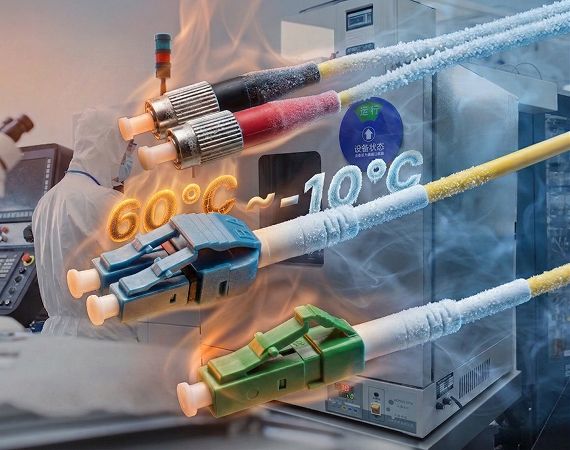
What is the Impact of Temperature on Fiber Optic Patch Cords?
Our fiber patch cords are built to thrive in data centers and everyday indoor settings. Following the IEC 61753-1 Category C standard, we test for temperatures from -10°C to +60°C and humidity levels between 5% and 93% RH. These are the exact conditions found in standard offices, indoor garages, and telecom centers. To guarantee long-term reliability, we run four different temperature stress tests in-house to monitor both Insertion Loss (IL) and Return Loss (RL).

5 Structural Factors That Impact Quality and Reliability
Temperature changes put stress on five key parts of a connector: 1) the glass fiber, 2) epoxy, 3) zirconia ferrule, 4) stainless steel spring, and 5) plastic housing. Epoxy application is especially critical. It must fill the ferrule bore to hold the fiber tightly without any air bubbles. Most importantly, the epoxy can never reach the back spring—that spring has to move freely so the connector faces keep perfect physical contact for a clear signal.

IEC 61300-2-22: Surviving Sudden Thermal Shock
What happens when temperatures suddenly swing? Our thermal shock test cycles cables from -10°C to +60°C. This aggressive test reveals vulnerabilities caused when materials like glass, ceramic, and plastics expand at different rates. It is designed to catch "fiber pistoning," a tiny push-and-pull movement inside the ferrule that can create air gaps between connectors and completely ruin your signal. We make sure that physical failure simply doesn't happen.

IEC 61300-2-18: Beating Dry Heat and Aging
Hot equipment rooms can slowly bake your cables. To prevent this, we bake ours at +60°C for 96 hours straight. This high-temperature test evaluates how well our epoxies and plastics handle accelerated aging and dry heat. Extreme heat can soften adhesives, allowing the bare fiber to shift microscopically inside the ferrule. We run this test to ensure the ferrule-fiber interface holds strong over time, keeping your optical connection totally stable.

IEC 61300-2-17: Fighting Cold Weather Shrinkage
Cold environments are just as tough on cables. We expose our patch cords to -10°C for 96 hours. Freezing temperatures cause plastic jackets and boots to shrink and get stiff, which can crush the glass fiber inside. This "microbending" is a major reason for sudden light leakage and IL spikes. We also check if the ferrule shrinks, which creates tiny gaps between endfaces that bounce light back and mess up your network connection.

IEC 61300-2-19: Damp Heat & Constant Humidity
High humidity is a silent network killer. We test our cables at 40°C with 93% humidity for 96 hours to see how much moisture the materials absorb. Since epoxy is a polymer, it swells when it takes in water. This swelling creates stress that physically squeezes the fiber and changes the adhesive's grip. By monitoring this, we ensure our assemblies won't suffer from moisture-induced fiber displacement and will keep performing smoothly.

Going Beyond IEC Standards for Better Quality
We don't just meet international standards; we beat them. For example, the IEC 61753 standard says a Single Mode UPC Grade B connector can have an Insertion Loss up to 0.25dB. But as a premium OEM manufacturer, our Typical IL standard for LC, SC, FC, and ST connectors is a much stricter ≤0.15dB. Our internal testing limits are tougher because we want you to have the most stable and reliable data center cabling possible.
Your Reliable OEM Partner for Fiber Optic Patch Cords
Looking for a reliable fiber optic patch cord OEM manufacturer? We prove our quality by testing our products through extreme thermal shock and dry heat conditions, ensuring your insertion loss variation stays incredibly low. Because our internal IL and RL standards are stricter than the IEC 61753-1 rules, you can trust us with your brand's reputation. Click the link below to download our latest fiber optic patch cord catalog and upgrade your supply chain!
- Related Products
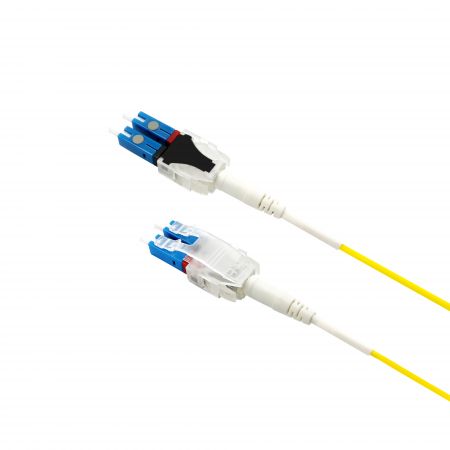
LC A/B Switchable Fiber Patch Cord
The LC A/B Switchable Fiber Patch Cord lets you reverse duplex polarity at the connector, from...
Details Add to List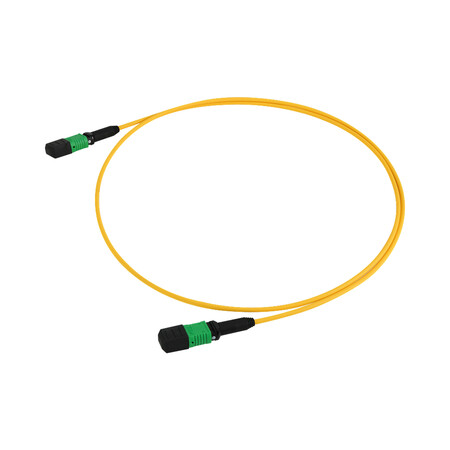
MTP®/MPO Array Cable
Every array cable is factory-terminated and individually tested before shipment, so link loss...
Details Add to List
1RU 3 Slots LGX Fiber Patch Panel with Modular Design | OEM/ODM Manufacturer
The LGX Fiber Patch Panel delivers a modular, precise fiber management solution built for data...
Details Add to List- Related FAQ
We verify our 4PPoE patch cords through Fluke DSX cable analyzer and Fluke LinkIQ cable network analyzer, ensuring the transmission performance and electrical resistance standards for PoE applications....
Read moreThe Modular Plug Terminated Link (MPTL) is a new “direct connect” link model where a horizontal cable is terminated and directly attached to a modular plug or a tool-free field termination plug. MPTL...
Read moreEXW places a high value on sustainability and offers innovative RJ45 paper packaging solutions to help customers meet their ESG goals. Our eco-friendly paper packaging options for RJ45 patch cords, keystone...
Read more- Files Download
RJ45 Copper and Fiber Optic Cabling System Products Catalog
LAN RJ45 and Fiber Optic Solution Catalog
Download